Archos
A source-grounded LLM system that turns the epistemic requirements of historical scholarship into architecture.
Archos is an epistemically grounded LLM system for archival exploration. It is built on one commitment: an AI system is only usable in the humanities if the requirements of scholarly practice are encoded into the architecture itself, rather than requested of the model in a prompt and hoped for in the output.
What makes it different
With Archos, historians remain in control of interpretation throughout. The system assists with evidence discovery, organisation and documentation; it does not adjudicate the history.
Our workflow

Where the historian sits in the loop
Archos is not an end-to-end answering machine. A domain expert writes the research statement that opens a run, and a domain expert verifies the report that closes it. Between those two points the system works under constraint: it retrieves archival evidence, holds it to an epistemic constitution, and synthesises only from what retrieval actually returned.
Reading an Evidence Report
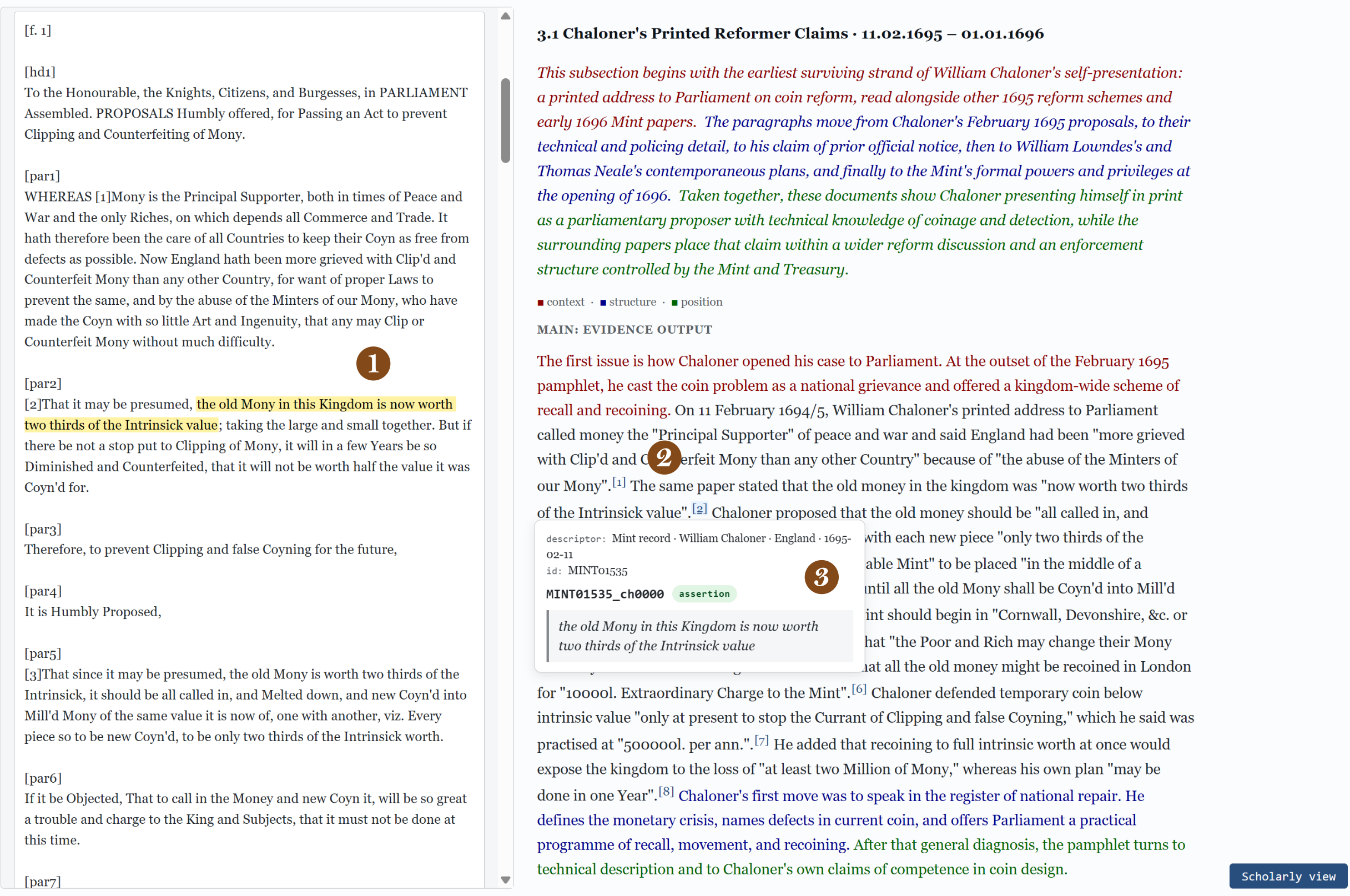
The system's output is an Evidence Report: the transcribed source on one side, the source-grounded synthesis on the other.
- A citable passage is highlighted in the transcribed archival source.
- Sentence-level citation — every evidence sentence carries its own footnote or footnotes.
- A provenance card appears on hover, giving the source id, date, verbatim quote and epistemic status.
Try it on your own material
We are looking for collections to test against. See get involved for what we need and what you get back.
Last updated .